How to reduce missing client tax documents
Most missing documents are predictable: last year's return already tells you who will send a form. This guide turns that into a request list, a completeness check and a follow-up schedule built around the IRS's own dates.
Updated 2026-10-17
If you want to reduce missing client tax documents, start with an uncomfortable fact: most of them were predictable. The brokerage that sent a 1099 last year will send one this year. The partnership that issued a K-1 last year will issue another, probably late. What goes wrong is rarely the client’s memory alone. It is a request that says “please send your tax documents”, a deadline that ignores when forms are actually issued, and a check for completeness that happens only when the preparer opens the file in March.
This guide sets out a process that fixes those three things. It works with any tool, including a spreadsheet, and it is built around the IRS’s own dates.
Why documents go missing
From the firm’s side, missing documents fall into a few recurring groups:
- Repeats the client forgot. A form from a payer that also issued one last year: a bank 1099-INT, a 1098 from the mortgage servicer, a K-1.
- New items nobody asked about. A new brokerage account, a home sale, a new job, a state change.
- Forms that are not out yet. Brokerage statements and K-1s that arrive on a later schedule than W-2s.
- Wrong or incomplete items. The prior-year form, a different spouse’s account, page one of a twelve-page consolidated statement.
- Corrected forms. A replacement 1099 that arrives after the original was used.
Each group needs a different fix. The first is solved by the request list, the second by questions, the third by timing, and the last two by a completeness check.
Step 1: Build the request list from last year’s return
The prior-year return is the best checklist you have. Before the season, list every source that produced a form last year, by payer:
| From last year’s return | Request this year |
|---|---|
| Each W-2 employer | W-2 from that employer, or confirmation the job ended |
| Each 1099-INT, 1099-DIV and 1099-B payer | Form from that payer, by name and last four digits of the account |
| Consolidated brokerage statement | The complete statement, all pages |
| Each Schedule K-1 | K-1 from that entity, by name |
| Form 1098 mortgage interest | Form 1098 from that servicer |
| Estimated tax payments | Dates and amounts paid, federal and state |
| Schedule C or E activity | The same summary or ledger you received last year |
Name the payer on every line. “1099-DIV from [brokerage name], account ending 4417” is easier to act on than “investment documents”. The client can see what they owe you without interpreting a category.
Step 2: Ask about change, briefly
Then add a short list of yes/no questions that catch what last year cannot predict. Keep it short; long questionnaires get skipped or answered “N/A” across the board.
- Did you open or close any bank or investment accounts?
- Did you buy or sell a home or other real estate?
- Did anyone in the household start or stop a job, or start a business?
- Did you move to or work in another state?
- Did you receive any K-1s from an investment we haven’t seen before?
- Did you receive a letter from the IRS or a state?
A “yes” turns into a specific request. A “no” against an account that sent a form last year turns into a question: was the account closed?
Step 3: Make the checklist easy to use
A client-friendly checklist is short, specific and dated:
- Plain names. “Mortgage interest statement (Form 1098)” rather than “1098”.
- Expected dates. Tell clients when each kind of form usually arrives, based on the IRS deadlines below, so they don’t wait for everything before sending anything.
- One place to send things. A portal, a request list, or a single secure upload link. Not a mix of email, text messages and a shared drive.
- Phone-friendly. Many clients will photograph a form rather than scan it.
Organizers or checklists?
Full organizers collect a lot of detail and suit complex returns. For many clients, a short checklist built from last year plus the change questions above is easier to complete, because the client can finish it in one sitting. Many firms use both: the checklist for every client, the organizer only for clients whose returns need it.
Step 4: Time the follow-ups to when forms are issued
The IRS sets when payers must furnish statements to recipients. For statements covering 2025, the IRS General Instructions for Certain Information Returns (2025) give February 2, 2026 for Forms 1098, 1099, 3921, 3922 and W-2G (January 31 fell on a Saturday), and February 17, 2026 for Forms 1099-B, 1099-DA, 1099-S and 1099-MISC with amounts in box 8 or 10 [1]. The later date also applies to statements furnished as part of a consolidated reporting statement [1], which is why brokerage packages arrive after bank forms.
Pass-through K-1s run later still. A calendar-year partnership’s Form 1065 is generally due March 15, and a weekend or holiday moves it to the next business day, so the 2026 date was March 16; each partner’s K-1 is due on or before the day the return is required to be filed [2]. An S corporation must provide Schedule K-1 to each shareholder on or before the day its Form 1120-S is required to be filed; for calendar-year S corporations the 2026 due date was March 16, because March 15 fell on a Sunday [3]. Both can file Form 7004, and the automatic extension is generally six months [4], so a K-1 from an extended entity can arrive months after the client’s other documents.
A follow-up cadence that matches those dates:
| When | What to send |
|---|---|
| Early January | The request list and change questions, with expected dates for each item |
| Second week of February | Reminder for W-2s, 1098s and bank 1099s, which should be in hand |
| Late February | Reminder for consolidated brokerage statements |
| Mid to late March | Check which K-1s have arrived; ask clients to forward each one as it comes |
| Early April | Decide, client by client, whether to extend for anything still outstanding |
Every follow-up should name what is still missing. “We still need your 1099 from [brokerage name] and your K-1 from [partnership name]” is more useful to a client than “Please send your remaining documents”.
Step 5: Check completeness when documents arrive, not in March
The moment a document arrives is the cheapest time to find a problem with it. Check, as items come in:
- Right year and right taxpayer. Prior-year forms and the other spouse’s account are common.
- Complete. All pages of a consolidated statement; every account the payer reported last year.
- Against the prior-year payer list. Anything from last year that hasn’t arrived, or that the client marked N/A, gets a question now.
- Marked Corrected. If a form is marked Corrected, replace the original in the file and note it.
Doing this at intake means that by the time a preparer opens the file, the list of what’s missing is already accurate.
Step 6: Plan for late K-1s and corrected 1099s
Some documents will be late no matter what you do. Plan for them explicitly:
- Keep a K-1 tracker. For each client, list the entities expected to issue K-1s, whether each arrived last year and when. The entities that were late last year are the ones to watch.
- Decide on extensions early. Form 4868 gives individuals until October 15 to file, but the extension is only for filing; any tax owed should be paid by the April filing date [5]. Estimate the K-1 income from last year if you need to.
- Expect corrections. The IRS instructions direct filers who find an error to correct it as soon as possible, and corrected statements go to recipients [1]. That can happen after the original statement date, so ask clients to forward anything marked Corrected, and be cautious about filing returns with heavy brokerage activity the moment statements arrive.
Step 7: Measure, then adjust next year
At the end of the season, note for each client which items were late, which were wrong, and how many follow-ups it took. Next year, those clients get an earlier start and a more specific list. Keep the payer list current as accounts open and close.
Running the request list in InflowSheet
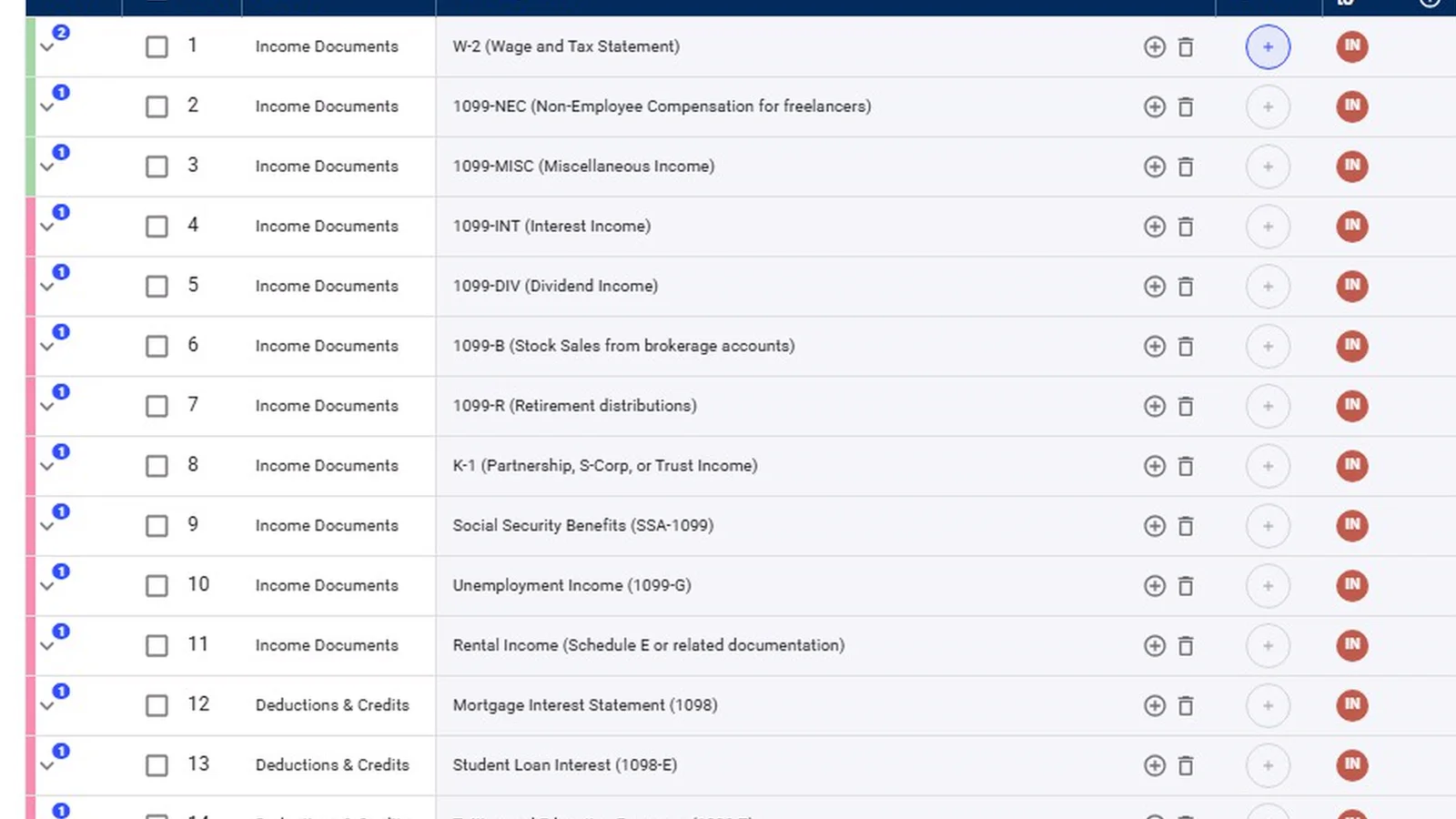
Any of this can run on a spreadsheet and email. InflowSheet is one way to run it on a shared list where the client answers each item. The request list serves as the tax document checklist, one per engagement and period, and can be built from a previous engagement, a saved template, or an Excel upload.
- Clients upload straight onto the item. They can drag and drop up to 30 files at 10 MB each, or take a photo with a phone camera. Clients see the list as “My Documents”.
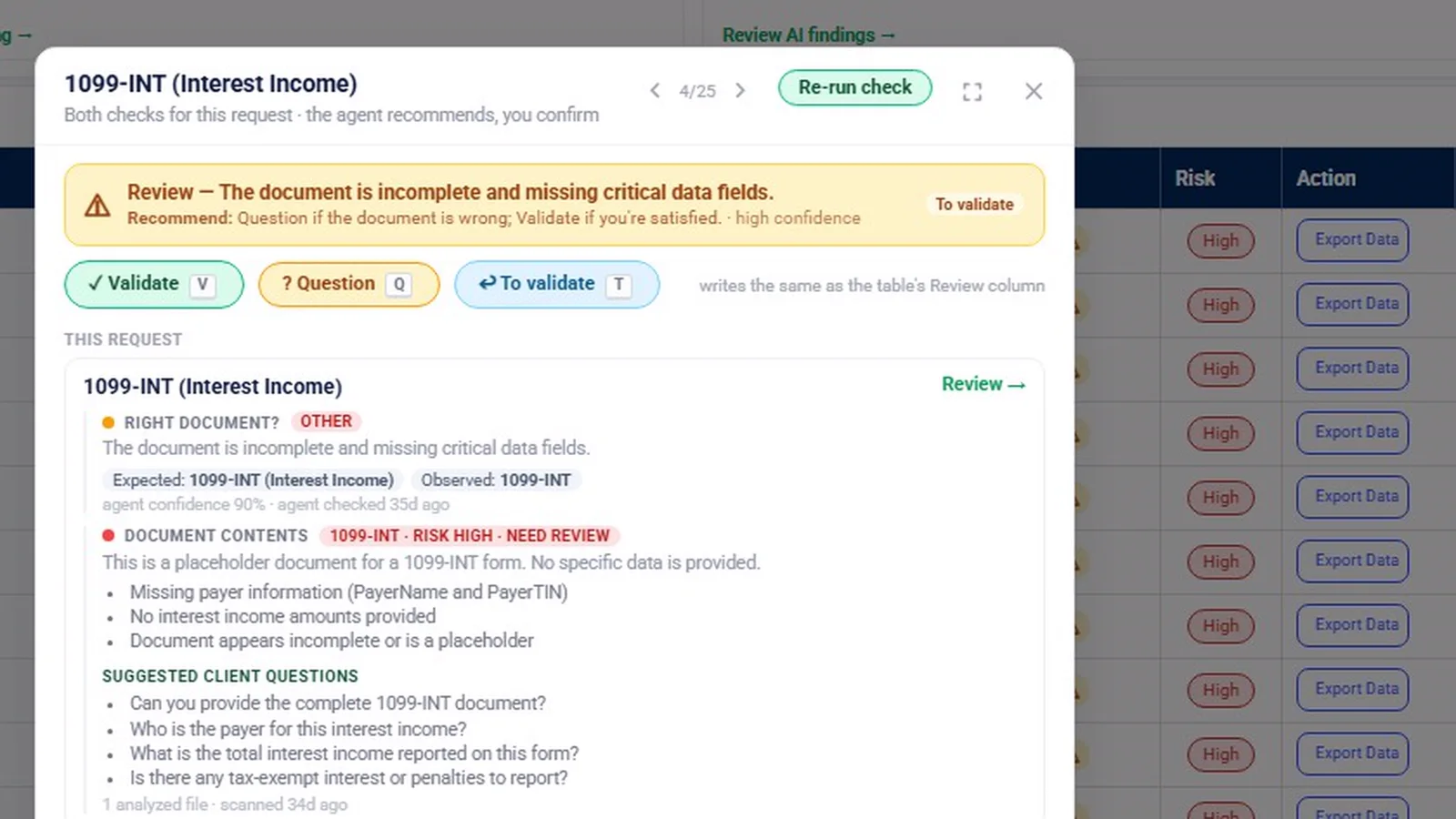
- A completeness check at intake. The completeness agent compares each received document with what was requested (wrong type, wrong year, wrong entity) and shows expected vs observed. It only recommends; a person validates or questions the item.
- The Missing tab and attention cards show what is still outstanding and what is waiting on the firm.
- Follow-ups drafted for approval. A Chase agent drafts a follow-up naming what is outstanding, and nothing is sent until someone approves it. Autonomous sending is opt-in, for routine items only, with a 15-minute hold before a reminder email goes out.
- Validated documents feed the Source Organizer, which rolls figures from validated W-2s, 1099s, 1098s and K-1s into return-relevant numbers.
What it does not do: InflowSheet has no client questionnaire-style organizer (the Source Organizer works from validated documents), it does not e-file returns, and it has no integrations with tax preparation software. See client document collection, the tax workflow overview, and the K-1 collection guide. Pricing is $10 per user per month (pricing).
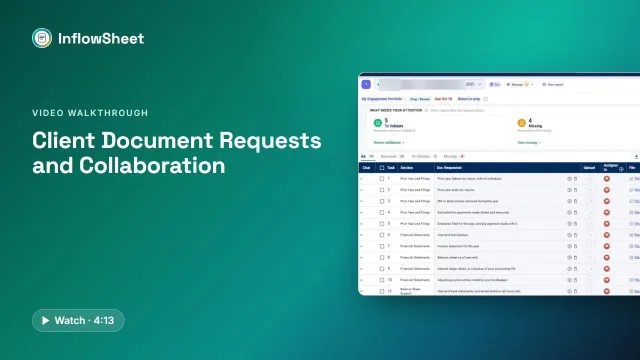 Full walkthrough · 4:13 · access requiredClient document requestsOne request list per engagement: what came in, what is wrong with it, and what to send next.
Summary
Missing documents are mostly a planning problem. Build the request list from last year’s return, name every payer, ask a few questions about change, time follow-ups to the IRS statement dates, check completeness when items arrive, and plan for late K-1s and corrected forms instead of hoping they won’t happen. The audit-side equivalent is in how to organize audit PBC requests.
Questions firms ask
How do I stop chasing clients for missing documents?
Ask for specific documents, not categories, using last year's return as the list. Give each item a payer name and an expected date, check completeness when items arrive, and follow up on a fixed schedule tied to when forms are actually issued.
How do you get clients to send tax documents early?
Send the request list before forms arrive, so clients know what to watch for, and tell them which items they can send in February and which will come later. Clients who know a brokerage statement comes mid-February are less likely to hold everything until it does.
Clients mark N/A on the organizer for accounts that did have forms. How do we catch it?
Compare what the client sent against last year's payer list before you start preparation. Any payer that issued a form last year and is missing or marked N/A this year gets a specific question, such as whether the account was closed.
Should we extend or wait for a late K-1?
If the K-1 is not in hand when you need to finish, extending is usually cleaner than filing and amending. Form 4868 gives individuals until October 15 to file, but it is not an extension of time to pay, so estimate and pay any balance by the April deadline.
When do corrected 1099s show up?
Whenever a payer finds an error and issues one, which can be after the original statement date. Ask clients to forward any form marked Corrected, and avoid filing returns with large brokerage activity in the first days after the mid-February statement date.
Sources
- IRS: General Instructions for Certain Information Returns (2025) (retrieved 2026-10-17)
- IRS: Instructions for Form 1065, U.S. Return of Partnership Income (retrieved 2026-10-17)
- IRS: Instructions for Form 1120-S, U.S. Income Tax Return for an S Corporation (retrieved 2026-10-17)
- IRS: Instructions for Form 7004 (retrieved 2026-10-17)
- IRS: Get an extension to file your tax return (retrieved 2026-10-17)
Related
See InflowSheet on your own engagements
Start with the free 90-second tour, or request access and we will walk you through it.