How CPA firms manage K-1 collection
K-1s decide when many individual returns can be finished. This guide covers the incoming side (the K-1s your 1040 clients are waiting on) and the outgoing side (the K-1s your firm issues for 1065 and 1120-S clients).
Updated 2026-10-17
K-1 collection is the part of tax season where the firm has the least control. A client can send W-2s and 1099s in February. A K-1 from a fund or an operating partnership arrives when the entity is ready, and that is often after the firm would like to be done with the 1040. Firms that manage K-1 collection well do not make K-1s arrive sooner. They know early which K-1s are expected, which entities have extended, and which returns are blocked, so nobody is surprised in April or September.
This guide covers both directions. Most firms have incoming K-1s (issued to individual clients by partnerships, S corporations, estates and trusts) and outgoing K-1s (issued by the firm’s own 1065 and 1120-S clients to their owners).
The deadlines that drive K-1 timing
Every K-1 plan starts from the entity’s filing calendar, because the K-1 deadline follows it.
- Partnerships. A domestic partnership generally files Form 1065 by the 15th day of the third month after its tax year ends, so March 15 for a calendar-year partnership. When that date falls on a weekend or legal holiday, the next business day counts, which made the 2025-year deadline March 16, 2026 [1]. The partnership must give each partner a Schedule K-1 “on or before the day on which the partnership return is required to be filed” [1].
- S corporations. An S corporation generally files Form 1120-S by the 15th day of the third month after year end, and must give each shareholder a Schedule K-1 on or before the day the 1120-S is required to be filed. For calendar-year S corporations the 2026 due date was March 16, because March 15 fell on a Sunday [2].
- Extensions. Both entity types extend with Form 7004, filed by the regular due date. The automatic extension is generally six months [3]. For a calendar-year partnership or S corporation, that moves the return, and therefore the K-1, to September 15 (a Tuesday in 2026).
- Individuals. Form 4868 gives an individual until October 15 to file. The IRS is explicit that “the extension is only for filing your return”: tax owed is still due by the April date [4].
The gap between those dates is the problem. A K-1 from an extended partnership can arrive in September, a few weeks before the extended 1040 is due. Firms that track this well know in March which entities have filed Form 7004, so the individual extension decision is made with facts, not on April 14.
There is also a reason for the issuing entity to care. The 2025 Form 1065 instructions describe a penalty, per Schedule K-1, for failing to furnish it when due or for furnishing it with incorrect information [1].
Build the expected K-1 list from last year
The most reliable predictor of which K-1s a client will receive is the list of K-1s they received last year. Start there, in January, before the first K-1 arrives.
- Pull last year’s K-1s for each 1040 client. Use the prior-year return or the prior-year document file. Record the issuing entity, its EIN, and the entity type.
- Ask the client what changed. Include a short question in the first request of the season: any new investments, sales, or entities that were wound up? A sold interest still produces a final K-1, which is easy to miss.
- Make one row per expected K-1. A client with six K-1s needs six rows. A single “K-1s” line hides the fact that five arrived and one did not.
- Record the expected date. For entities your firm prepares, you know it. For outside entities, use last year’s arrival date as the starting estimate and update it once you learn whether they extended.
This list becomes the reason a return is or is not ready. When a preparer asks whether a client’s 1040 can be finished, the answer should come from the rows, not from someone’s memory of an email.
A K-1 tracker you can copy
Whether you keep it in a spreadsheet or a system, the columns below answer the questions partners actually ask. The rows show the kinds of situations a tracker has to hold; they are illustrations, not data.
| Client | Issuing entity | Form | Entity deadline (2026) | Extended? | Expected | Received | Version | Blocks return? | Next step |
|---|---|---|---|---|---|---|---|---|---|
| Client A | Operating partnership | 1065 K-1 | March 16 | Yes, Form 7004 filed | Mid-September | Not yet | — | Yes (material) | Extend 1040; confirm date with entity |
| Client A | Real estate fund | 1065 K-1 | March 16 | Unknown | Late March (last year) | Yes | Original | No | Review boxes; check for state K-1 |
| Client B | Family S corporation (firm prepares) | 1120-S K-1 | March 16 | No | March 10 | Yes | Original | No | Ready to use |
| Client B | Brokerage-held partnership | 1065 K-1 | March 16 | Unknown | April (last year) | No | — | No (immaterial) | Decide: wait or file and amend |
| Client C | Partnership sold in 2025 | 1065 K-1 (final) | March 16 | Unknown | — | No | — | Yes | Ask client for contact at entity |
Three columns matter most. Extended? turns a vague “waiting” into a date. Blocks return? separates the K-1 that changes the answer from the one that adds forty dollars of interest. Version keeps amended K-1s from being confused with originals.
Chasing K-1s without nagging clients
Clients usually do not control when a K-1 is issued, so repeated reminders to the client frustrate everyone. A better pattern:
- Ask the client once for the contact. Investor relations email, fund administrator, or the entity’s CPA. Many entities post K-1s to an investor portal, so ask the client to forward the notification or add the firm as a delegate where the entity allows it.
- Ask the entity for its date, not the document. “Have you filed an extension, and when do you expect K-1s?” gets a useful answer in March.
- Batch the follow-ups. Review the tracker weekly from late February. A short list of outstanding K-1s, grouped by entity, is quicker to work than a pile of individual reminders.
- Write down the extension decision. When the partner decides to extend because of a missing K-1, record that on the row. When the K-1 arrives in September, the reason for the extension is already in the file.
Corrected and amended K-1s
Amended K-1s arrive every year, sometimes after the individual return is filed. The IRS instructions describe how entities issue them:
- A partnership that files an amended Form 1065 gives the partner a copy of the amended Schedule K-1 and checks the “Amended K-1” box at the top [1]. An S corporation does the same with the “Amended K-1” box on the shareholder’s K-1 [2].
- Partnerships under the centralized (BBA) audit regime work differently. A BBA partnership that needs to change a filed return files an administrative adjustment request (AAR), and the instructions say it “shouldn’t file an amended tax return or amended Schedules K-1” [1]. The effect reaches partners through the AAR process rather than as an ordinary amended K-1, so a client may receive a statement that looks different from what you expect.
For the firm, the process is the same either way. Log the new document against the original row, compare it box by box, note which lines changed, and decide with the client whether the change is large enough to amend. Keep the original and the amended version side by side. Without that, a reviewer looking at the file a year later cannot tell why two numbers disagree.
When your firm issues the K-1s
For 1065 and 1120-S clients, the firm is on the other side. The partners or shareholders are now the people waiting.
- Confirm the roster before you finalize. Names, addresses, email addresses and ownership changes during the year. Every partner during the year needs a K-1 [1], including one who left in June.
- Agree on the delivery method. If owners will get K-1s electronically, settle how they consent, how they prove who they are, and what happens for anyone who wants paper.
- Match each K-1 to the right person. With a dozen owners, a mismatch is easy and serious. Match on more than the name.
- Track delivery. Know who opened their K-1, whose email bounced, and who still needs paper. That record is what you point to when an owner says they never received it.
- Plan for amendments. If the entity amends, the same roster and delivery process is used again, with the amended box checked.
How InflowSheet handles K-1s
This section describes InflowSheet, the engagement platform we build. The process above works with any tool. Here is how it maps onto ours.
Incoming K-1s for 1040 clients. Each engagement and period has one request list, which the firm works from and the client answers. Expected K-1s sit on it as their own rows, next to W-2s and 1099s. A list can be built from a previous engagement, a saved template, or from scratch. When a client rolls into a new period, responsible people carry forward and due dates move 12 months ahead, while statuses, chat and received files start fresh. That gives you last year’s K-1 rows as this year’s starting list.
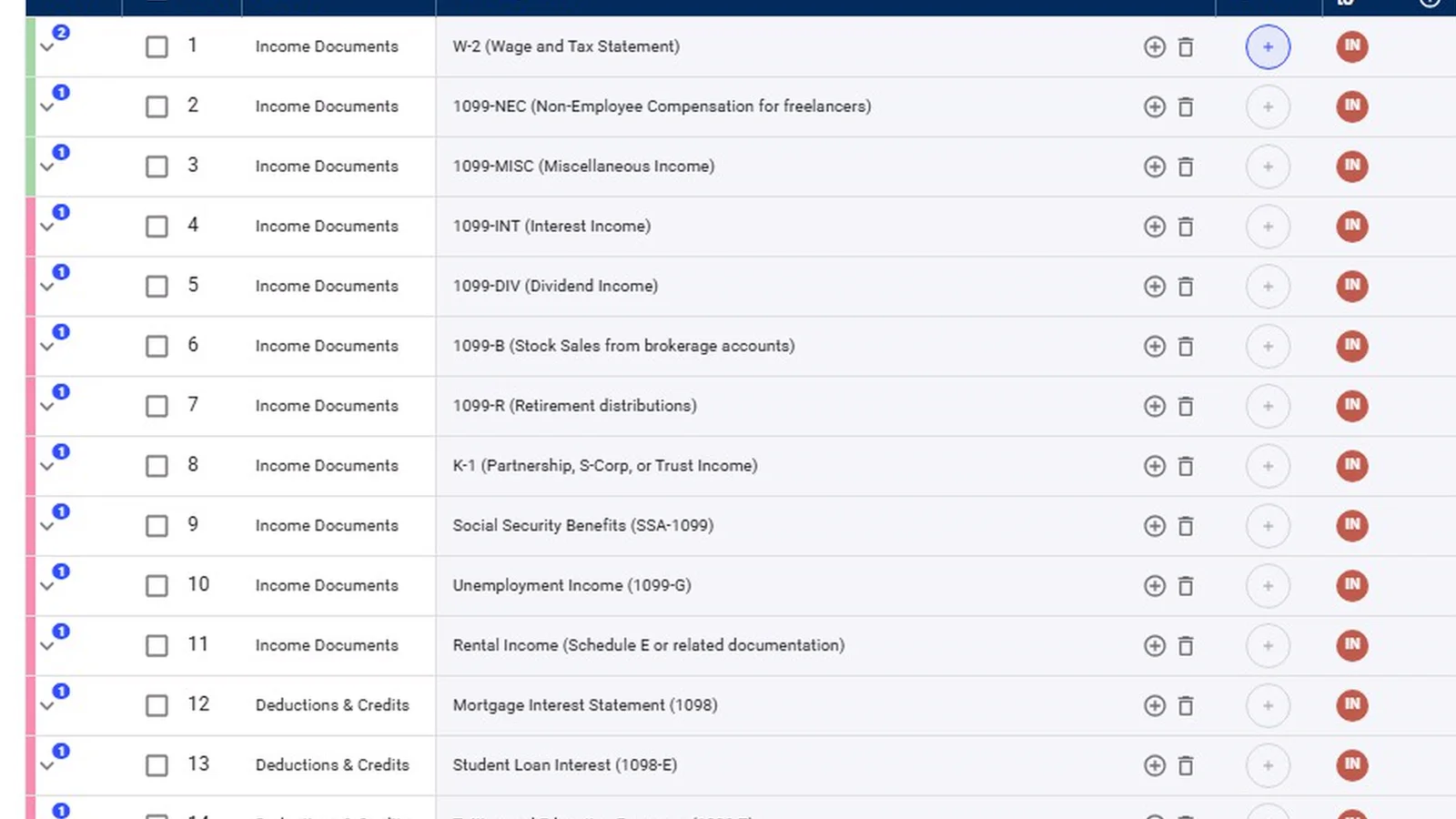
Clients upload straight onto the row. A completeness agent compares the document with what was requested and flags the wrong type, wrong year or wrong entity, but the agent only recommends: a person validates or questions the item. For missing K-1s, a Chase agent drafts a follow-up naming what is outstanding, and by default nothing goes to the client until someone approves it. Once K-1s are validated, the Source Organizer rolls their figures up into return-relevant numbers. (The organizer card appears in the demo, but the demo has no organizer items.)
Outgoing K-1s for 1065 and 1120-S clients. The K-1s page runs in five steps: K-1s, Recipients, Match, Send and Track. The firm drops in the K-1 PDFs and pastes a partner roster with name, email and the last four digits of the TIN. Matching reads the recipient from each K-1 and proposes a person; it never confirms on its own. Recipients get a notice rather than the K-1 itself, verify their email with a one-time code, agree to electronic delivery and then download. A paper option exists. Each recipient’s state is tracked, such as a bounced email, withdrawn consent or paper required, and a K-1 chase agent drafts reminders.
 Full walkthrough · 4:19 · access requiredTax workflow and returnsFrom source documents to a signed 8879: organizer, Tax Returns, ERO signing order, K-1s and 1099s.
What it does not do. InflowSheet does not e-file returns, does not connect to tax preparation software, and does not route K-1s into partner returns. It holds the request, the document, the review and the distribution record. More of the tax side is on the tax workflow page, and the general request-list approach is on client document collection. Pricing is $10 per user per month, with every user getting the whole platform (pricing).
A K-1 collection checklist for the season
- January: build the expected K-1 list from last year’s returns, one row per K-1.
- February: ask each client about new and sold interests; collect entity contacts.
- Early March: ask outside entities whether they have filed Form 7004.
- Mid-March: mark which missing K-1s block a return; brief partners on likely extensions.
- April: extend where a material K-1 is outstanding, and record why on the row.
- Through September: log late and amended K-1s against their original rows.
- After the season: keep the list. It is next year’s starting point.
If missing documents in general are the bigger problem, see how to reduce missing client tax documents.
Questions firms ask
How do I track which clients are still waiting on K-1s?
Keep one row per expected K-1, not one row per client. Seed the list from the K-1s each client received last year, then record the issuing entity, its filing deadline, whether it extended, and the date the K-1 arrived.
Why are K-1s so often late?
A partnership or S corporation cannot finish its K-1s until its own return is done, and many entities extend. A valid extension moves the return due date by up to six months, and the K-1 deadline follows the return due date.
Should we extend the 1040 or file and amend when a K-1 is missing?
That is a judgment for the engagement partner and the client. Most firms extend when a material K-1 is outstanding near April, because an individual extension runs to October 15 but does not extend the time to pay.
What should we do when a client receives an amended K-1 after we filed?
Log it against the original K-1 row, compare the changed boxes, and decide with the client whether the change requires an amended individual return. Keep both versions in the file so the reason for any amendment is clear.
Does InflowSheet route K-1s into partner returns?
No. For K-1s your firm issues, InflowSheet reads each K-1 and proposes a recipient, and a person confirms the match. It does not file returns or push K-1 data into tax software.
Sources
- IRS, Instructions for Form 1065 (2025) (retrieved 2026-10-17)
- IRS, Instructions for Form 1120-S (2025) (retrieved 2026-10-17)
- IRS, Instructions for Form 7004 (12/2025) (retrieved 2026-10-17)
- IRS, Get an extension to file your tax return (retrieved 2026-10-17)
Related
See InflowSheet on your own engagements
Start with the free 90-second tour, or request access and we will walk you through it.